
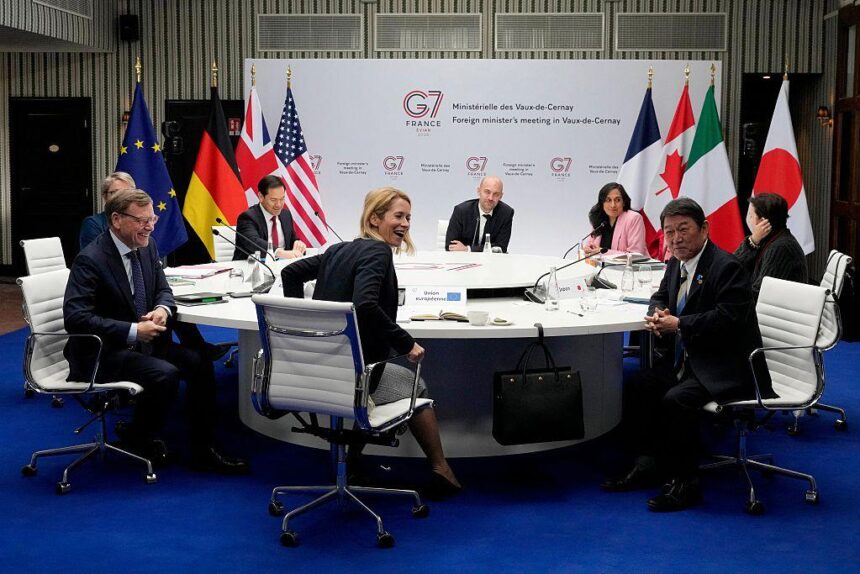
Foreign ministers from the world’s leading industrialised democracies have gathered in Paris for discussions on the conflicts in Ukraine and Iran, global security and the future of international cooperation. US Secretary of State Marco Rubio faces important questions from European allies about Washington’s foreign policy direction following the Republican Party’s major midterm election losses.
A critical diplomatic meeting
The Group of Seven brings together the United States, United Kingdom, Canada, France, Germany, Italy and Japan.
The November 9 meeting in Paris is taking place during a period of significant international uncertainty.
According to the Associated Press, the two-day discussions will address several unresolved international crises, including the Russia-Ukraine war, the conflict involving Iran, energy security and artificial intelligence.
The meeting also provides an opportunity for European governments to assess whether the US administration’s political situation will influence its international commitments.
More Read

Ukraine remains a major concern
One of the most important issues is the continuing war between Russia and Ukraine.
European governments are concerned that any potential peace agreement must protect Ukraine’s sovereignty and long-term security.
Washington is preparing for further diplomatic discussions involving Russian and Ukrainian representatives in Abu Dhabi.
More Read

European leaders want to ensure that decisions affecting European security are not made without European participation.
The negotiations could become an important test of cooperation between Washington and its European allies.
Iran and energy security
The situation involving Iran is another major issue.
The conflict has created diplomatic and economic uncertainty, particularly around regional security and energy transportation.
The Strait of Hormuz is especially important because it is a major international route for oil and other energy shipments.
Disruptions in the region can affect energy prices, transportation costs and economic stability across Western countries.
More Read

European governments are expected to encourage diplomatic solutions and discuss how to avoid further regional escalation.
AI and international competition
Artificial intelligence is also part of the wider diplomatic agenda.
The G7 countries are facing questions about AI governance, technological competition, cybersecurity and the strategic importance of semiconductor supply chains.
The rapid expansion of AI has created opportunities for economic growth but also introduced new national security challenges.
Cooperation among major economies could become increasingly important as governments attempt to establish common approaches to emerging technologies.
Why the summit matters to Americans
The discussions have direct implications for the United States.
Foreign policy decisions can influence:
- US relationships with NATO and European partners.
- Military and diplomatic commitments.
- International energy prices.
- Trade and technology cooperation.
- Global financial market confidence.
For American businesses, predictable international relationships are particularly important during periods of geopolitical uncertainty.